
MQL to SQL Calculator and Lead Goal Planner
See your conversion rate at every stage, from lead to won deal. Then work back from a revenue goal to the SQLs, MQLs and leads it takes. Free, no sign-up, your numbers stay in your browser.
The calculator needs JavaScript. The formulas are below.
From MQL to SQL, and Back From a Revenue Goal
The MQL to SQL rate is the share of marketing qualified leads that sales accepts as sales qualified: SQLs ÷ MQLs × 100, for the same period.
Turned around, the same rates tell marketing how many leads a revenue goal needs. Every stage is rounded up, because half a deal doesn’t close.
The formulas
- MQL to SQL rate = SQLs ÷ MQLs × 100
- Deals needed = revenue goal ÷ average deal size
- SQLs needed = deals ÷ SQL-to-won rate
- MQLs needed = SQLs ÷ MQL-to-SQL rate
- Leads needed = MQLs ÷ lead-to-MQL rate
Try a Ready Example
Example values to see how the numbers move. They are not benchmarks.
- Example
Last Quarter’s Funnel
2,000 leads, 400 MQLs, 120 SQLs, 60 opportunities and 15 won deals.
- 20%lead to MQL
- 30%MQL to SQL
- 12.5%SQL to won
- Lead Goal
$1M in 12 Months
At $25,000 per deal: 40 deals, 200 SQLs, 667 MQLs and 3,335 leads.
- Small Team
A $250,000 Goal
At $10,000 per deal: 1,000 leads, about 84 a month.
- What If
A Better MQL to SQL Rate
From 30% to 40% in the $1M plan: 500 MQLs instead of 667.
- Quarter
A Quarterly Target
$300,000 at $25,000 per deal: 12 deals, 60 SQLs, 200 MQLs and 1,000 leads.
Get Your Counts From Pardot and Salesforce
The rate is only as good as the definitions behind it.
- 1
Agree What MQL and SQL Mean
Write down the score and grade that make an MQL and what sales does to accept one. Without that, every quarter counts differently.
- 2
Pull One Period
The lifecycle report in Account Engagement (Pardot) or the B2B Marketing Analytics funnel shows MQLs and SQLs; otherwise a report on your lead status.
- 3
Calculate Your Rates
Enter the counts. The calculator shows every stage rate and flags counts that don’t add up.
- 4
Plan the Next Goal
Switch to Lead Goal with your own rates in one click, and take the monthly lead target to your next planning meeting.
Know Your Funnel Without a Spreadsheet
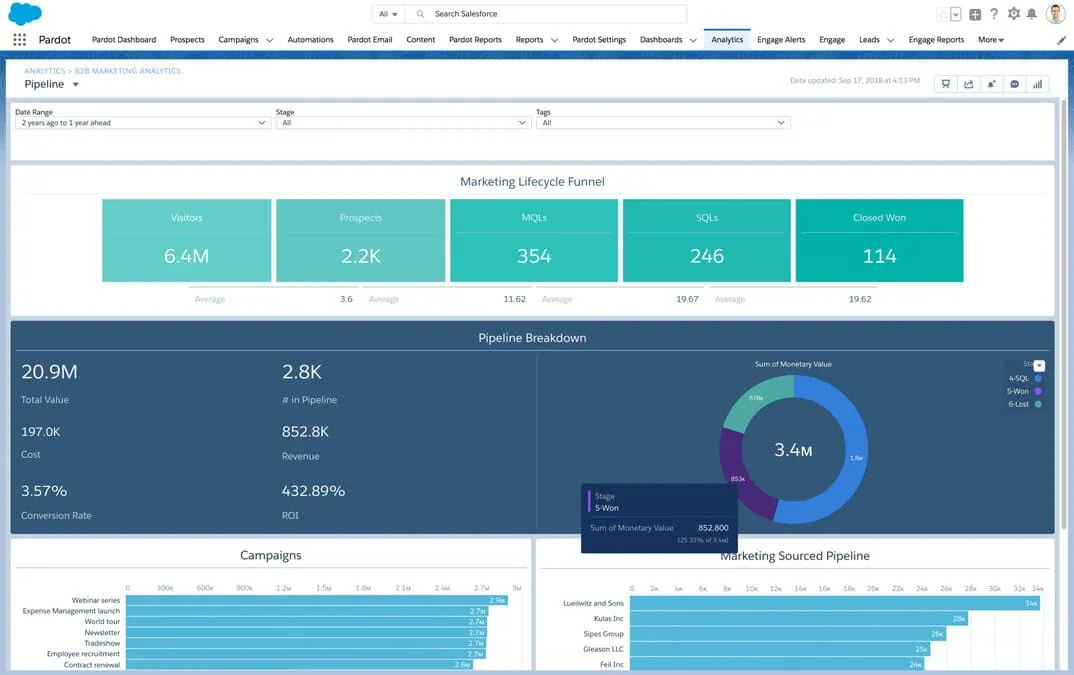
B2B Marketing Analytics shows the funnel from visitors to closed won deals, from Pardot and Salesforce data. Pardot’s lifecycle report counts an MQL when a prospect is assigned to a user and an SQL when an opportunity is created.
If those definitions don’t match how your team qualifies leads, the rates mislead. We set up scoring, assignment and reporting so they match.
- MQL and SQL defined once, used everywhere
- Salesforce reports on the funnel
- Lead goals your sales team signs off
More Free Tools
MQL to SQL Calculator FAQ
Short answers to what people ask about MQL to SQL rates and lead goals.
How do I calculate the MQL to SQL conversion rate?
Divide the SQLs by the MQLs of the same period and multiply by 100: 120 SQLs ÷ 400 MQLs × 100 = 30%.
What is a good MQL to SQL conversion rate?
Published figures differ a lot, and few say how they defined an MQL. A rate that falls after you lower the score threshold is expected; a rate that falls with the same definition is a signal. Compare your own quarters.
What is the difference between an MQL and an SQL?
An MQL (marketing qualified lead) meets the bar marketing set, usually a score and fit threshold. An SQL (sales qualified lead) is one sales has checked and accepted as a real sales opportunity in the making.
How many leads do I need to hit my revenue goal?
Divide the goal by the average deal size for the deals you need, then divide by each stage rate in turn: SQL to won, MQL to SQL, lead to MQL. Switch the calculator to Lead Goal and it does this for you.
Which period should I use?
One at least as long as your sales cycle, so the SQLs had time to come from the MQLs you count. With a short period, recent MQLs haven’t converted yet and the rate looks low.
Are my numbers stored?
No. The calculator runs in your browser. Nothing you enter is sent to us or to analytics. The share link keeps the numbers after the #, a part of the address browsers never send to a server.
We Make Salesforce Marketing Work for You
Talk to a certified consultant, not a salesperson, and leave the first call knowing your next step.