Pardot vs Account Engagement What Marketers Need to Know
Why Salesforce renamed Pardot to Marketing Cloud Account Engagement in 2022, why the name still causes confusion, and what it may signal for Salesforce marketing.

In 2022 Salesforce renamed Pardot to “Marketing Cloud Account Engagement”. This article looks at why, why the new name still causes confusion, and what it signals for Salesforce’s marketing technology strategy.
More than a year later, marketers, admins and consultants are still divided on whether the new name has caught on or Salesforce should go back to “Pardot”.
- Salesforce renamed Pardot to Marketing Cloud Account Engagement in 2022, as part of its “Salesforce Easy” naming initiative.
- The four-word name is often shortened to “Account Engagement”, which many people associate with Sales Cloud.
- Search trends, certification names and job ads still lean toward “Pardot”.
- Adding “Marketing Cloud” to the name may point to a more unified Salesforce marketing platform ahead.
Why “Pardot” Was Rebranded
The renaming of Pardot to Marketing Cloud Account Engagement (MCAE) was part of Salesforce’s broader “Salesforce Easy” initiative – a move aimed at simplifying product naming and improving clarity across the expansive Marketing Cloud portfolio. While Pardot had brand equity, it didn’t overtly signal that it was a marketing tool to outsiders. By contrast, “Marketing Cloud Account Engagement” attempted to put function front and center.
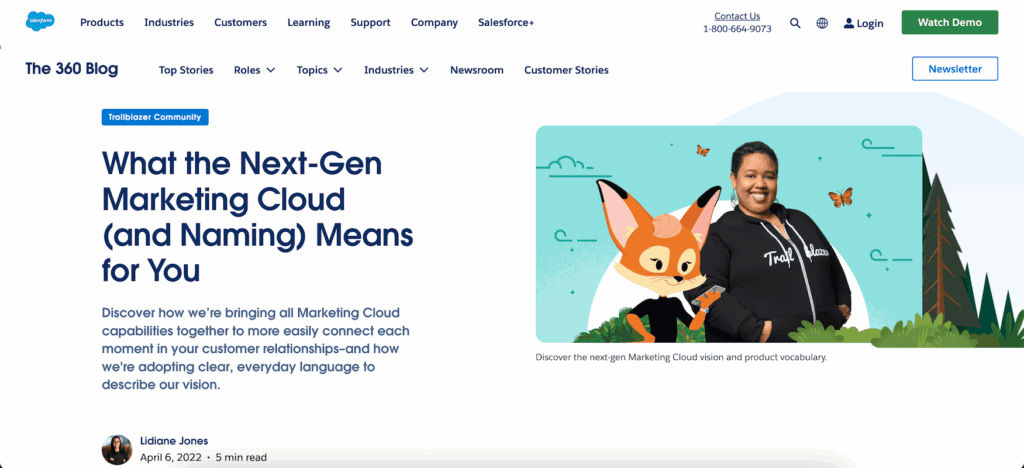
But clarity and consistency come at a cost. The new name is longer, clunkier, and arguably less memorable. While Salesforce quickly rolled out the new terminology across the UI, documentation, and training resources, community adoption has lagged. The transition is far from complete.
The Case for Simplicity
There’s no denying it – simplicity matters in branding. The word “Pardot” was short, distinct, and had developed strong brand recognition over the years.
- “Marketing Cloud Account Engagement” clocks in at four words – an anomaly within Salesforce product naming.
- The term is frequently shortened to “Account Engagement,” which creates new confusion (more on that later).
- Acronyms like MCAE have not caught on, and even Salesforce discourages their use internally.
Some in the community have proposed “SFPC” (Salesforce Pardot Cloud) as an alternative abbreviation – attempting to blend legacy familiarity with the current brand architecture. But this too has yet to take root.
From a usability standpoint, names like “Account Engagement Engagement Studio” are clunky and repetitive – making it harder for users to talk about features clearly and confidently.
Confusion Across the Ecosystem
“Marketing Cloud Account Engagement” was meant to provide clarity, but in many ways, it’s introduced ambiguity. Overlapping terminology confuses both internal teams and prospective users.
Account Engagement vs. Sales Cloud
The term “Account” is strongly associated with Sales Cloud, leading some users to assume “Account Engagement” is part of the sales toolset rather than a marketing automation solution. This mismatch can dilute understanding across marketing and sales teams – particularly in complex B2B organizations.
Account Engagement vs. Marketing Cloud
The confusion deepens within the Marketing Cloud umbrella. Account Engagement and Marketing Cloud Engagement (formerly ExactTarget) are fundamentally different platforms:
| Tool | Primary Use Case |
|---|---|
| Account Engagement (Pardot) | Lead nurturing, scoring, B2B marketing |
| Marketing Cloud Engagement | Multi-channel campaigns, personalization at scale, B2C marketing |
The name “Account Engagement” suggests a broader overlap with other Marketing Cloud tools. Even in search results, users are led to documentation that doesn’t match the product they actually use – resulting in mismatched expectations and missed functionality.
Engagement Everywhere
Salesforce’s frequent use of the terms “Engage” and “Engagement” across its products – Salesforce Digital Engagement, Marketing Cloud Engage, and others – only adds to the fog. As product portfolios grow, so does the need for naming discipline.
Behavioral and Technical Adoption
Brand changes are more than just logos and landing pages – they trigger waves of user adaptation in systems and search behavior, not to mention recruiting and certifications.
User Interface and Settings
The UI transition from “Pardot” to “Account Engagement” may have served as the nail in the coffin for nostalgia. Tabs, labels, and app names have all been updated:
- “Pardot Settings” became “Account Engagement Settings”
- The Lightning App is now listed as “Account Engagement”
- Field labels have shifted, making workflows unintuitive for seasoned users
Search Behavior
Despite the UI shift, the term “Pardot” still dominates online searches. Based on the search trend data for August 2025, “Pardot” continues to be searched multiple times more than “Marketing Cloud Account Engagement”.
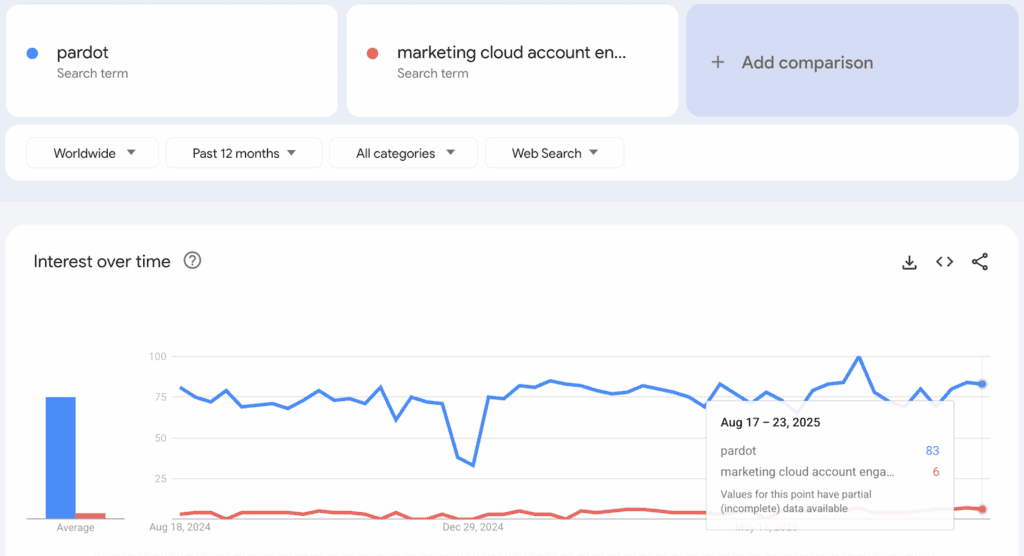
We’re in a transitional phase where both terms coexist – and likely will for the foreseeable future.
Job Descriptions and Certifications
The job market hasn’t caught up. While certifications still list “Pardot” (e.g. Pardot Specialist, Pardot Consultant), new partner accreditations reflect the updated branding. This disconnect affects hiring and skill identification:
- Job seekers may struggle with searchability if employers use outdated or inconsistent terminology
- Professionals risk being overlooked because their certifications say “Pardot” while job listings ask for “Account Engagement” expertise
| Legacy Term | Current Equivalent |
|---|---|
| Pardot Specialist | Marketing Cloud Account Engagement Specialist |
| Pardot Consultant | Marketing Cloud Account Engagement Consultant |
Salesforce’s Track Record with Renaming
This isn’t Salesforce’s first (or most complex) name change. Several products have evolved their names to reflect brand alignment or technology shifts:
- ExactTarget → Marketing Cloud Engage
- Wave → Einstein Analytics → Tableau CRM → CRM Analytics
- Customer Audience 360 → Salesforce CDP → Genie → Data Cloud → Data 360
- Quip → Salesforce Anywhere → Quip (again)
Some names stuck. Some didn’t. In many cases, Salesforce refined naming to match enhanced capabilities. With Pardot, the rename came before substantive feature additions – especially related to account-based marketing (ABM), a capability conspicuously absent from a product now focused on “Account” engagement.
Looking Ahead
So what does all this tell us about Salesforce’s marketing automation roadmap? There are subtle hints that Salesforce could be moving toward a unified, platform-wide approach to marketing technology:
- Adding “Marketing Cloud” to the product name may signal consolidation across marketing tools
- There’s credible speculation that Salesforce is developing a single Marketing Cloud platform within the next few years
- True ABM functionality could help the name “Account Engagement” live up to its promise
Key Takeaways
The “Pardot” vs. “Account Engagement” debate isn’t settled yet, but some things are becoming clear:
- The new name is aligned with Salesforce’s strategic branding efforts, but may inadvertently cause more complexity than clarity
- Search trends, certification nomenclature, and job market adoption still skew toward “Pardot”
- Salesforce may need to introduce real functionality around account-based marketing to validate the current naming direction
- The community may benefit from more flexible terminology – perhaps even a Salesforce-approved acronym
Every name change involves technology, strategy, adoption and a bit of human psychology. Whether you call it Pardot or Account Engagement, our advice stays the same: understand the platform, educate your stakeholders, and choose your terminology for your audience.
Looking beyond Pardot? Marketing Cloud Next Explained for Pardot Users shows what Salesforce is building next and whether your licence already includes it.
If you’re working through your own Account Engagement changes or need help matching your strategy to what the platform can do, get in touch with us. We help you get the most out of Salesforce’s marketing stack, whatever it ends up being called.