
Pardot Pricing: Every Edition Compared
Pardot (Account Engagement) pricing: Growth+, Plus+, Advanced+ and Premium+ compared, what each includes, which add-ons cost extra, and how to pick.

Pardot (Account Engagement) costs $1,250, $2,750, $4,400 or $15,000 per Salesforce org per month at list price, for the editions Growth+, Plus+, Advanced+ and Premium+, billed annually (Salesforce, October 2026). Each edition includes 10,000 mailable contacts (Premium+: 75,000) and, under Salesforce's conditions, access to Marketing Cloud Next, whose usage is paid in credits on top.
- Pardot lists at $1,250 (Growth+), $2,750 (Plus+), $4,400 (Advanced+) or $15,000 (Premium+) per Salesforce org per month, billed annually on an annual contract, and every edition requires Salesforce Enterprise or Unlimited Edition.
- You pay per org; only a few add-ons are priced per user, and the included 10,000 contacts (75,000 in Premium+) count the mailable prospects in your database.
- The "+" editions are the same Pardot with Marketing Cloud Next access added under Salesforce's conditions; using Marketing Cloud Next is billed in credits.
- On Plus+, the custom object and dedicated IP add-ons bring you within $750 a month of Advanced+, so compare the two before you sign.
- Check what your current licence already includes before anyone sells you a separate Marketing Cloud Next licence.
How Much Does Pardot Cost?
Every price is per Salesforce org and billed annually, and "All per month products require an annual contract."
| Edition | List price per org per month | Per year (12 months) | Contacts included | Marketing Cloud Next edition included |
|---|---|---|---|---|
| Growth+ | $1,250 | $15,000 | 10,000 | Growth |
| Plus+ | $2,750 | $33,000 | 10,000 | Advanced |
| Advanced+ | $4,400 | $52,800 | 10,000 | Advanced |
| Premium+ | $15,000 | $180,000 | 75,000 | Advanced |
Source: Salesforce, Marketing Cloud Account Engagement Pricing (US), checked 16 October 2026. The German page shows the same numbers in euros. Prices are "subject to change"; what you pay is on your order form. The basics are in what Pardot is and what it does.
The Pardot price isn't the whole bill. Salesforce Help says all four editions require Salesforce Enterprise or Unlimited Edition, so if your CRM runs on Professional Edition, budget that upgrade as well.
What Does the "+" in Growth+, Plus+, Advanced+ and Premium+ Mean?
The "+" means the edition includes access to Marketing Cloud Next through permission set licences, which Salesforce calls Account Engagement+. Pardot itself stays the same product:
"MCAE is still sold; the "+" means MC Next PSLs are included." (Salesforce, What is Marketing Cloud?)
For your contract: the pricing FAQ says existing customers "do not need to renew on a new SKU". Help adds that the name Account Engagement+ "doesn't appear on your order form or contract". For editions ending in "-LP", Help says the edition "is no longer sold and doesn't include next-gen access".
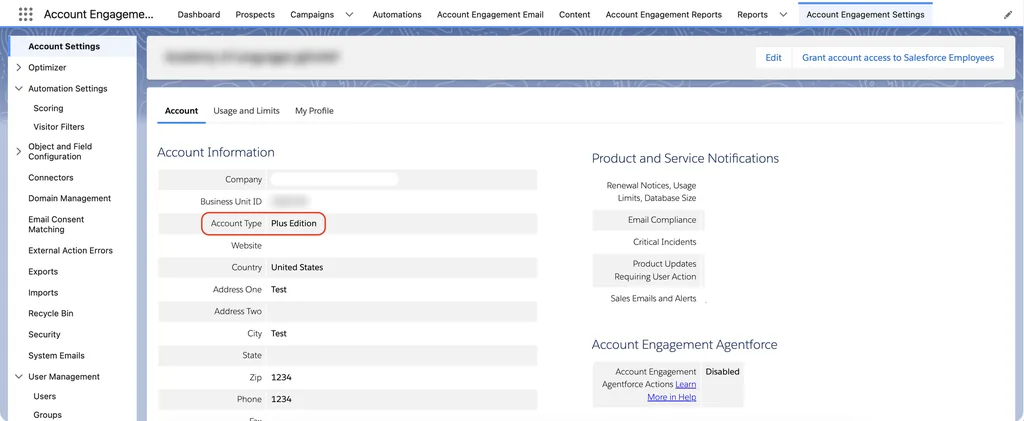
What Does Each Pardot Edition Include?
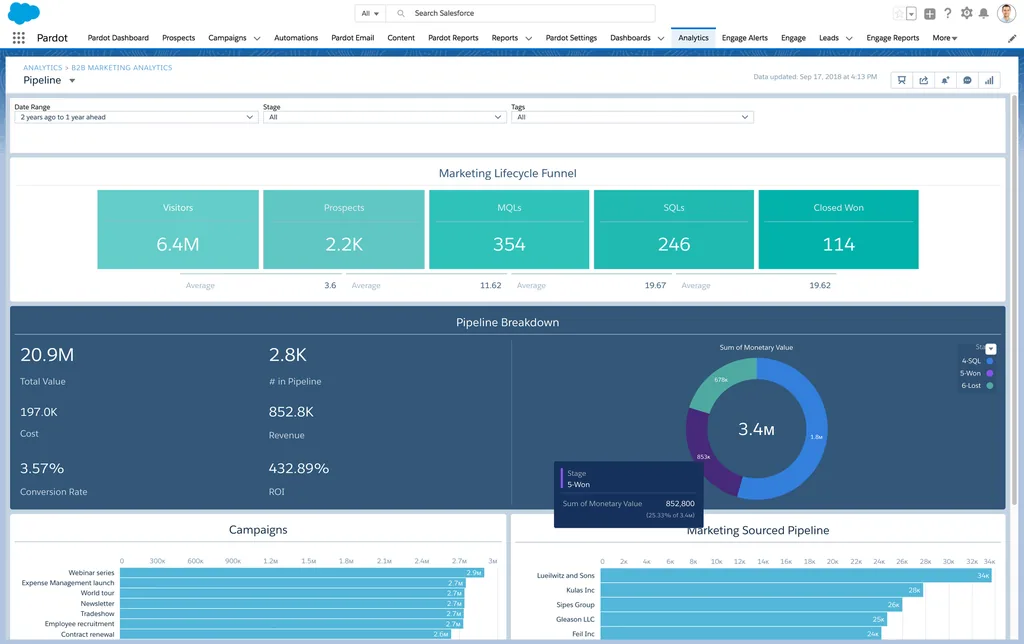
All four editions share the core: prospect tracking, lead scoring and grading, Engagement Studio, forms, landing pages, email A/B tests, ROI reporting and the Salesforce connector.
| Feature (Salesforce's name) | Growth+ | Plus+ | Advanced+ | Premium+ |
|---|---|---|---|---|
| Lead Scoring and Grading | Yes | Yes | Yes | Yes |
| Forms, form handlers, landing pages | 50 each | Unlimited | Unlimited | Unlimited |
| Automation rules | 50 | 100 | 150 | See your contract |
| Running Engagement Studio programs | 20 | 100 | 200 | 200 |
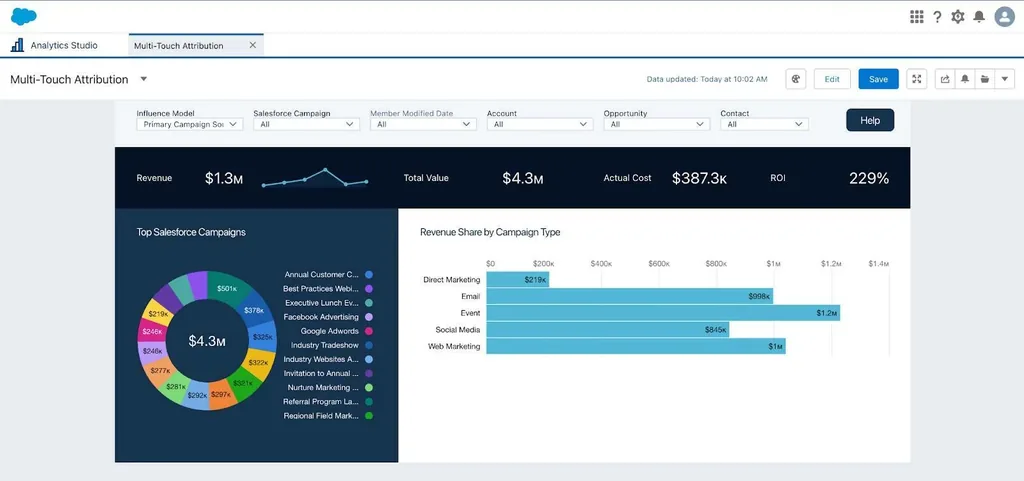
| Multiple Scoring Categories, Rule-Based Account Scoring, Multi-touch Attribution Models | No | Yes | Yes | Yes |
| Advanced Dynamic Content | $400/month | Yes | Yes | Yes |
| Google Ads Integration | No | Yes | Yes | Yes |
| B2B Marketing Analytics | No | 5 licences | 5 licences | 5 licences |
| Custom Object Integration | No | $400/month | Yes | Yes |
| Dedicated IP Address | No | $500/month | Yes | Yes |
| Einstein Lead Scoring, Behavior Scoring, Campaign Insights | No | No | Yes | Yes |
| Custom User Roles and Permissions, Partitioning | No | No | Yes | Yes |
| Business units included | No | No | 2 | 5 |
| Developer sandboxes | No | Add-on | 2 | 5 |
| API calls per day | 25,000 | 50,000 | 100,000 | 100,000 |
Sources: Salesforce pricing grid and Help (Account Engagement Limits, Create a Sandbox for Account Engagement), checked 16 October 2026. For Premium+ automation rules, Salesforce's pricing grid and Help give different numbers, so we leave the number out; your contract settles it. Programs and rules that aren't running don't count toward their limits.
Some limits are the same in every edition, according to Help: up to 800 custom fields mapped to Salesforce (Salesforce recommends fewer than 150 prospect fields across leads and contacts), 5 API requests at a time, import files up to 100 MB and hosted files up to 50 MB.
Lead Grading Is in Every Edition
Salesforce's grid lists "Lead Scoring and Grading" in all four editions. What starts at Plus+ is more than one score: scoring categories (for example one score per product line) and rule-based account scoring.
10,000 Contacts Are Mailable Prospects
The allowance is a ceiling on your database, not a monthly sending volume. Help explains:
"This limit is based on the sum of all mailable prospects across all of your business units. Unsubscribed prospects aren't counted toward this limit." (Salesforce Help, Account Engagement limits)
Mailability depends on "the Do Not Email field, the Opted Out field, and previous email bounces." A prospect in the recycle bin is, in Help's words, "not eligible to receive any emails" either. So the count rises with every new mailable prospect and falls when prospects opt out, are set to Do Not Email, bounce or are moved to the recycle bin.
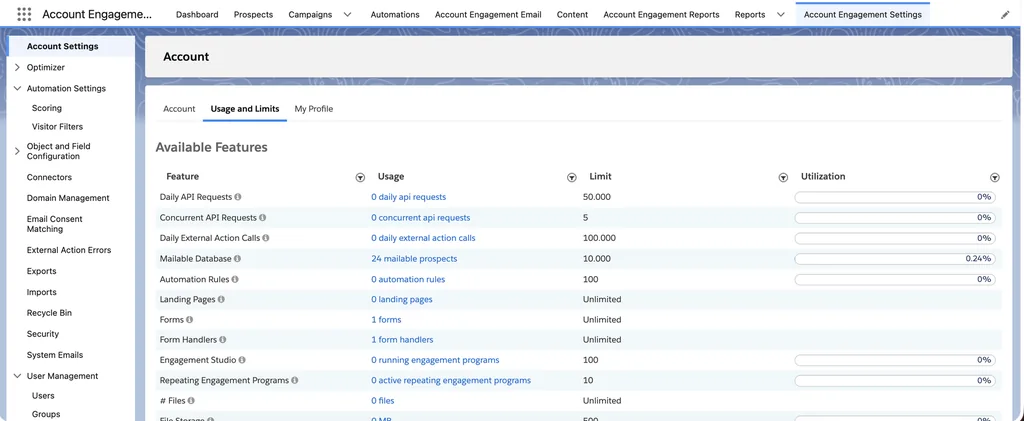
Extra contacts are sold in blocks of 10,000. Salesforce's pricing page shows one price on the add-on card and different prices per edition in the grid, so ask for a quote before you plan with a figure.
Which Pardot Add-Ons Cost Extra?
Salesforce lists its add-on prices in US dollars, even on the German page. These are the ones with a single published price.
| Add-on | List price | Where it applies |
|---|---|---|
| B2B Marketing Analytics Plus | $3,000 per user per month | Plus+, Advanced+ (5 licences included in Premium+) |
| Sales Emails and Alerts | $50 per user per month | Each sales user who gets it |
| Advanced Dynamic Content | $400 per month | Growth+ |
| Custom Object Integration | $400 per month | Plus+ |
| Dedicated IP Address | $500 per month | Plus+ |
| Additional business units | $2,000 per unit per month | Advanced+, Premium+ (up to 25 in total) |
| Premier Success Plan | 30% of net licence fees | Any edition; included in Premium+ |
Sales Emails and Alerts also gives access to Distributed Marketing and Alerts and the Unified Engagement History Dashboards in Marketing Cloud Next. Missing on purpose: additional contacts (see above) and SMS and WhatsApp. Both messaging channels are add-ons in every edition, sold as credits, and Salesforce's Pardot and Marketing Cloud Next pricing pages show different starting prices per 1,000 credits.
To see which of these you pay for and actually use, a Pardot audit with a prioritised action plan starts with that list. The reporting add-ons are covered in our guide to B2B Marketing Analytics.
What Does Marketing Cloud Next Cost on Top of Pardot?
The licence access is included in Growth+ to Premium+ under the conditions below; using it costs credits:
"Account Engagement customers will need to purchase Einstein Request Credits, Messaging Credits, and Data 360 Credits to use Marketing Cloud Next features." (Salesforce, Marketing Cloud Account Engagement Pricing)
Access depends on conditions: Sales Cloud or Service Cloud Enterprise Edition or higher, a Data 360 (formerly Data Cloud) licence, a supported region and Lightning Experience. The Data 360 licence can come from Salesforce Foundations, which Salesforce describes as "available at no cost" and which brings a starter allowance of credits. Salesforce's pages name different amounts for it, so check your Digital Wallet and order form.
| What you do in Marketing Cloud Next | Uses credits? | Salesforce source |
|---|---|---|
| Bring leads and contacts in from Salesforce CRM | No, since 7 August 2025 | Help, Data 360 billable usage types |
| Bring Pardot activity in through the Account Engagement connector | Yes, per activity | Help, Account Engagement data in Data 360 |
| Identity resolution (merging leads and contacts into one profile) | Yes, at a far higher rate per million rows than segments or web tracking | Flex Credits rate card, 31 August 2026 |
| Publishing segments, building and previewing them | Yes | Help, segmentation billing |
| Website tracking | Yes | Help, Flex Credits usage types |
| Using Marketing Cloud Next in a sandbox | Yes | Help, sandbox testing |
| Marketing Performance Intelligence dashboards | Yes | Help, Marketing Performance Intelligence |
| Letting the Campaign Creation agent build a segment from your description | Yes, Data 360 credits | Help, Campaign Creation agent |
| SMS and WhatsApp | Yes, messaging credits | Pricing pages |
Orgs that bought Data 360 credits before 24 February 2026 have Data Services credits; orgs that buy or renew after that date can have Data Services credits or Flex Credits. Data 360 Flex Credits list at $500 per 100,000 credits.
Keep one active identity resolution ruleset per object: Salesforce says a second one increases the bill. Budget for the Pardot activity rule before you connect Pardot to Data 360: "each ingestion consumes Data 360 credits," says Help. How credits are counted, with a worked example, is in our article on Data 360 pricing and credits.
Two allowances don't clearly apply to Pardot customers. Salesforce's allocation table gives 180,000 (Growth) or 360,000 (Advanced) email credits a year to the Marketing Cloud Next editions, while the Pardot pricing FAQ says Account Engagement customers need to buy messaging credits. And since 24 October 2025 most AI features in Marketing Cloud Growth and Advanced no longer count Einstein requests, but Account Engagement+ isn't on that list. We plan both as paid credits until your order form says otherwise.
What each Marketing Cloud Next edition includes is in what Marketing Cloud Next is and what Pardot teams get, and the difference between the two editions in Marketing Cloud Next Growth vs Advanced.
Which Pardot Edition Should You Choose?
Our rule: choose by the first limit you would hit, then check whether an add-on costs less than the next edition.
- Growth+ is enough for one brand with up to 50 forms, 50 form handlers and 50 landing pages, one score per prospect and up to 20 running Engagement Studio programs.
- Plus+ is the next step when you need more than 50 forms or landing pages, a separate score per product line, account scoring, multi-touch attribution or B2B Marketing Analytics. It is the smallest edition with Marketing Cloud Next Advanced.
- Advanced+ makes sense when several brands or regions need their own business units, when admins need custom user roles, or when you want Einstein scoring and sandboxes.
- Premium+ pays off with large databases (75,000 contacts included) and five business units out of the box; it also includes Premier Success, Bring Your Own Encryption Key and five B2B Marketing Analytics Plus licences.
A quick check at list price: Plus+ with Custom Object Integration and a Dedicated IP Address comes to $3,650 a month. Advanced+ costs $750 more and adds Einstein scoring, two business units, custom user roles and two sandboxes. If you need both add-ons, compare that gap before you sign. Salesforce also states: "You are able to upgrade at any time as well as purchase additional products later on in your contract."
What this means for sales: every edition gives your reps a score and a grade on each lead and contact. Einstein Behavior Scoring, a 0 to 100 score that learns from prospects linked to opportunities, starts at Advanced+. Sales Emails and Alerts is priced per user, so budget it only for the reps who will use it.
Your Options
- Stay on your edition, or change it when you hit a limit, and use what you already pay for: our Pardot consulting covers scoring categories, custom objects and the rest.
- Add Marketing Cloud Next inside the licence you have: budget the credits first, then start with one simple campaign. Our Marketing Cloud Next consulting covers the setup next to Pardot.
- Move to Pardot from another tool: compare the editions above against your forms, scores and business units, then ask Salesforce for a quote on the edition that fits.
Frequently Asked Questions
Is Pardot Priced per User?
No. Pardot editions are priced per Salesforce org per month; only add-ons such as B2B Marketing Analytics Plus and Sales Emails and Alerts are priced per user. Each user still needs a Salesforce user, and to work in the Lightning app, per Salesforce's implementation guide, "the Account Engagement User, Sales Cloud User, Service Cloud User, or CRM User permission set license."
Do I Have to Buy Marketing Cloud Next Separately?
Not if you run Growth+ to Premium+ with Sales or Service Cloud Enterprise Edition or higher and meet Salesforce's other conditions (a Data 360 licence, a supported region, Lightning Experience): the licence access is included. You do buy credits for Einstein requests, messaging and Data 360 when you use it.
What Happened to Pardot Pro and Ultimate?
They are older edition names. Salesforce's own documentation pairs Pro with today's Plus and Ultimate with today's Advanced.
Is Pardot Cheaper Than Marketing Cloud Next?
At list price, Pardot Growth+ starts at $1,250 and Marketing Cloud Next Growth Edition at $1,500 per org per month, both billed annually. Marketing Cloud Next also charges for credits as you use it, so the total depends on your data and sends.


