Stop Spam on Pardot Form Handlers With These 6 Tips
Protect Pardot form handlers from spam with six proven tactics that boost lead quality without hurting user experience.

Pardot Form Handlers offer unparalleled flexibility when integrating third-party or custom forms with Marketing Cloud Account Engagement. But with that flexibility comes a tradeoff – limited out-of-the-box spam protection. If you’ve ever opened your Pardot form submission logs to find a torrent of junk leads, you’re not alone. Spam submissions, whether from bots or humans, can derail your marketing efforts and compromise data quality.
This article outlines six proven tactics to prevent spam on Pardot form handlers without damaging the user experience for your legitimate prospects.
- Form handlers have little built-in spam protection: you have to add it yourself.
- Use Google reCAPTCHA, and a honeypot field that only bots fill in.
- Multi-step forms and processing submissions on your own server first make it harder for bots.
- Filter by patterns in junk leads, and as a last resort replace a burned form handler with a new URL.
Why You Need to Protect Pardot Form Handlers
Unlike native Pardot Forms, form handlers rely entirely on you to implement front-end validation. That leaves them vulnerable to script-based bots, rogue IPs, and even manual spammers. If left unchecked, spam can:
- Clog your lead database, making it harder to identify real prospects
- Degrade your email deliverability due to bad email addresses
- Pollute your CRM with irrelevant contacts
The goal is clear: block spam without creating friction for the real humans you want to convert. Here’s how to achieve both.
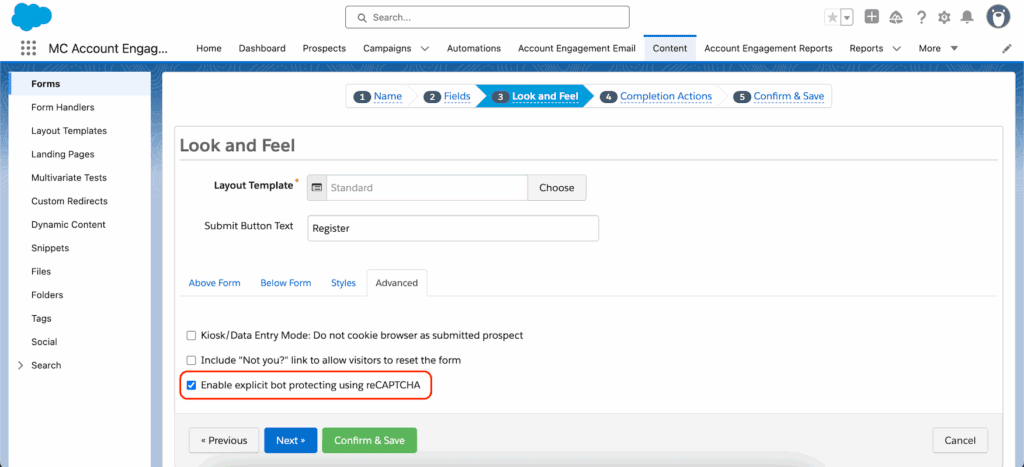
1. Enable Google reCAPTCHA
Google reCAPTCHA is a standard method to block bots by challenging them with a checkbox (“I’m not a robot”) or background behavior analysis. It’s lightweight and user-friendly, especially with the invisible v2 or reCAPTCHA v3 variants.
But there are limitations to keep in mind:
- It relies on JavaScript. If a bot bypasses JavaScript, reCAPTCHA won’t be triggered.
- Incorrect implementation or browser plugin interference can give false negatives.
Still, for most common spam bots, adding reCAPTCHA offers a strong first layer of defense.
2. Deploy the Honeypot Technique
Honeypots are hidden form fields that normal users never see – and thus never fill in. Bots, on the other hand, often auto-fill every field they encounter. If the honeypot is filled, it’s a telltale sign of a bot.
To implement a honeypot in Pardot form handlers:
- Add a hidden field to your HTML form – do not style it with display:none; as some bots skip those.
- Set up a Pardot form handler field mapped to that hidden form field.
- Create a Completion Action or Automation Rule to add any prospect with a value in the honeypot to a “Spam” list.
- Manually delete spam prospects from this list on a regular basis.
This method is effective, invisible to real users, and doesn’t rely on third-party services.
3. Use Multi-Step Forms
A good user experience is your best ally in fighting spam. Multi-step forms reduce form abandonment and make it harder for bots to complete the submission process.
Here’s why they work:
- Bots often attempt to submit all fields in a single pass – multi-step logic breaks that expectation.
- Even human spammers are less likely to invest time clicking through multiple screens.
- You can progressively disclose more detailed questions after gathering basic data on Step 1.
This approach requires front-end development work, but the payoff in lead quality and reduced spam is well worth it.

4. Preprocess Form Data on Your Server
Typically, a Pardot form handler sits directly on your website, and the form’s action points straight to Pardot. This makes the endpoint publicly visible – and vulnerable.
Instead, intercept form submissions on your own server first. This gives you the opportunity to:
- Run custom spam filtering logic, such as checking IP addresses, email domains, or time-to-fill metrics
- Sanitize or transform data before sending it to Pardot
- Keep Pardot’s endpoint URL hidden from bots
There are a few implementation options:
| Approach | Description |
|---|---|
| Submit to server first, then post to Pardot | Your server handles form validation before forwarding form data using the Pardot API or form handler POST request. |
| Iframe submission | Host the Pardot handler inside an iframe that loads only upon success, after validation occurs. |
This method involves more technical lift, so having a developer or technical consultant is essential.
5. Analyze and Filter Based on Submission Patterns
Post-submission analysis can help weed out entries that slipped past other barriers. Look for patterns in existing junk leads, such as:
- Free email addresses (like spammer@abc123.com)
- Strange naming conventions
- Non-business countries or IP clusters
You can also add simple validation prompts at the end of the form. For example:
- “What is the last letter of the word ‘London’?”
- “What is 1 + 1?”
Once this field is added in Pardot, you can create an Automation Rule that checks:
- If the answer is blank or incorrect, add the prospect to a spam list
- Mark the prospect as “Do Not Sync to CRM”
- Remove them from your usable database
6. Reset and Regenerate Your Form Handler
Sometimes a form handler gets burned beyond recovery. If bots have found the endpoint and flood it regularly, consider starting fresh by:
- Deleting the old form handler
- Creating a new one with a different URL
- Updating your website’s form action accordingly
It’s a last resort, but it effectively resets your spam footprint while giving you a clean slate to apply preventive measures from the start.
Should You Stop Using Form Handlers Altogether?
Native Pardot forms offer built-in protection mechanisms, but the customizability of form handlers makes them the go-to for many teams. Whether you’re tied to custom UX, web CMS restrictions, or advanced validation logic, banning form handlers isn’t realistic for most modern B2B marketing teams.
Instead, think of these tactics as your toolkit for keeping the power of form handlers while minimizing their vulnerabilities.
Final Thoughts
You don’t have to let spam dictate your form strategy. With careful planning and the right preventative steps, you can maintain clean data and better engage your prospects. Whether you’re using a quick fix like a honeypot or implementing server-side validation, every step you take protects your marketing investment.
Need help implementing these strategies or designing secure high-converting forms? Get in touch with our team and we’ll help you lock down your Pardot form handlers the right way.