Top Pardot FAQs Every B2B Marketer Should Know
Get clear answers to top Pardot FAQs and learn how Salesforce's B2B marketing platform supports lead gen, nurturing, and campaign reporting.

B2B marketing automation is evolving fast, and so are the questions surrounding which platforms can best support it. Salesforce Marketing Cloud Account Engagement – still often referred to by its original name, Pardot – remains a cornerstone solution for many organizations aiming to scale demand generation, lead nurturing, and campaign attribution. If you’re considering Pardot or want to maximize what you’re already using, you’re not alone.
We’ve pulled together answers to the most frequently asked questions to help marketers, sales teams, and executives better understand what Pardot does – and what it doesn’t.
- Pardot (Account Engagement) is Salesforce’s B2B marketing automation platform for lead generation and nurturing.
- It fits any “considered purchase” journey with a sales team, not only B2B.
- Salesforce runs CRM and the deal lifecycle; Pardot handles lead generation, nurturing, scoring and email.
- Salesforce acquired Pardot in 2013 as part of its $2.5B purchase of ExactTarget.
- Trailhead offers free modules to learn Pardot.
What Is Pardot and How Does It Work?
Pardot is Salesforce’s B2B marketing automation platform. Designed to streamline and scale lead generation and nurturing, its primary goal is to help you communicate with prospects in a personalized way at exactly the right time. Under the hood, Pardot uses a mix of behavioral and CRM data to manage the buyer’s journey – from anonymous visitor to marketing-qualified lead (MQL).
What types of data does Pardot use?
Pardot improves targeting and delivery by leveraging two main data streams:
- Behavioral Data: Actions a prospect takes, like email clicks, webpage visits, form fills, or social interactions.
- Demographic and CRM Data: Information such as job title, company size, industry, and more – frequently pulled from Salesforce or collected via forms.
By combining what prospects do with what you know about them, Pardot delivers timely, relevant content to move them through your marketing funnel.
What Is Pardot Used For?
While companies use Pardot in a variety of ways, here are the most common use cases that align with B2B sales cycles:
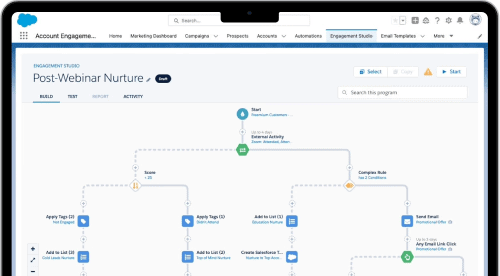
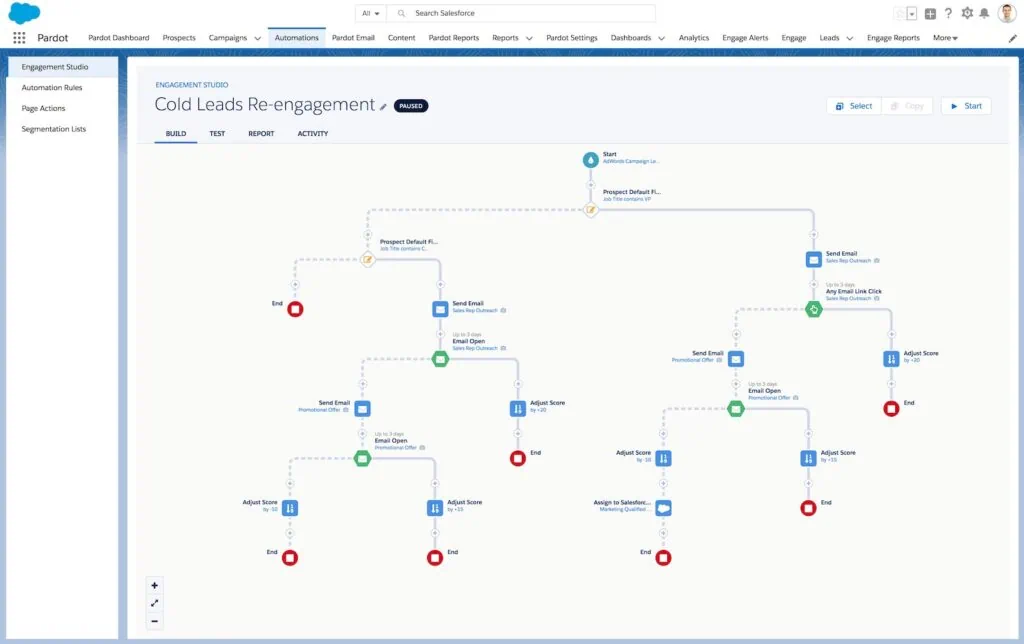
- Email marketing: Create one-time emails or multi-step nurtures (Engagement Studios) triggered by time or behavior.
- Lead capture via forms: Collect new data or enrich existing records through progressive profiling.
- Engagement history: Track each digital interaction to inform lead scoring and segmentation.
- Segmentation: Dynamically filter audiences based on criteria across behavior, demographics, or custom fields.
- Lead scoring and grading: Score captures interest level. Grade measures fit. The combination indicates sales readiness.
- Social posting: Publish to platforms like LinkedIn, Facebook, and Twitter and track engagement directly in Pardot.
- SEO and paid search: Monitor keyword performance and track SEM campaigns through connected platforms like Google Ads.
- Campaign reporting: Attribute revenue to marketing touchpoints using Campaign Influence and B2B Marketing Analytics.
Whether you’re nurturing long sales cycles, running ABM plays, or launching outbound campaigns, Pardot’s toolset is built with scalability and sales alignment in mind.
How Does Pardot Work with Salesforce?
Pardot’s deep integration with Salesforce is one of its strongest assets. This native connection allows the two platforms to exchange real-time data through the Salesforce-Pardot connector.
How the integration supports your funnel
| Funnel Stage | System Responsibility |
|---|---|
| Top of Funnel | Pardot: Acquisition via forms, content, and ads |
| Middle of Funnel | Pardot + Salesforce: Lead nurturing and qualification |
| Bottom of Funnel | Salesforce: Opportunity and deal progression |
This shared data model bridges gaps between marketing and sales. Leads collected in Pardot can be scored and qualified before surfacing in Salesforce. Likewise, opportunity data from Salesforce can trigger tailored marketing campaigns to accelerate deal cycles or influence renewals.
Is Pardot B2B Only?
Originally built with B2B in mind, Pardot is now positioned more broadly as a tool for “considered purchase” journeys – regardless of whether that customer is a business or consumer. If your buyers go through a longer decision-making process and interact with a sales team, Pardot likely fits.
B2C use cases include:
- Luxury goods with long evaluation cycles
- High-value consumer services
- Education or consulting programs
As long as your sales approach involves nurturing, personalization, and multiple touchpoints, Pardot is a viable engine – even in B2C scenarios.
Pardot vs. Salesforce: What’s the Difference?
Salesforce and Pardot serve distinct – but complementary – functions in your revenue engine.
| Platform | Primary Focus |
|---|---|
| Salesforce | CRM, deal lifecycle, pipeline management, service operations |
| Pardot | Lead gen, nurturing, scoring, email marketing |
Pardot acts as a gatekeeper to protect your CRM from unqualified leads, while Salesforce houses detailed sales and service interactions. Together, they offer a unified view from initial form fill to closed-won deal.
Can You Compare Pardot vs. MailChimp?
While Pardot and Mailchimp both offer email marketing capabilities, they differ fundamentally in structure, CRM integration, and reporting sophistication.
Key differences between Pardot and MailChimp
- Database Model: Pardot uses a single CRM-backed database with segmentation managed via dynamic and static lists. Mailchimp uses multiple audiences – where the same contact can exist in several audiences as separate records.
- CRM Integration: Pardot deeply integrates with Salesforce, syncing not only contacts but also campaign activity, opportunity stage data, and more. Mailchimp’s integration is more limited.
- Unique Identifier: Pardot keys off the Salesforce Lead/Contact ID, allowing for multiple email addresses if needed. Mailchimp identifies records by email address, flagging any duplicates.
- Reporting and Analytics: Pardot wins on campaign influence modeling and tracking full-funnel engagement history. Mailchimp offers strong built-in analytics but focuses mainly on email performance.
If Salesforce is your CRM of record and you’re invested in reporting on ROI, Pardot provides more depth and flexibility for B2B use cases.
What About Pardot vs. HubSpot?
This is a classic comparison in the world of marketing tech. Both platforms offer robust automation tools, but the focus and philosophy differ:
- HubSpot: Excels at inbound marketing, especially top-of-funnel audience building. Known for its ease of use and ecosystem of pre-built connectors.
- Pardot: Ideal for organizations centered around Salesforce and focused on bottom-of-the-funnel sales enablement workflows.
Pardot limits pre-built integrations but compensates with customizability through Salesforce extensibility (APIs, AppExchange, Webhooks). If your business relies heavily on Salesforce, Pardot is more strategically aligned with your ecosystem.
How Can You Learn Pardot?
Pardot skills are highly valuable for marketing teams aiming to scale Salesforce-powered lead gen. Fortunately, there are multiple ways to gain hands-on knowledge:
Free Training Resources
- Trailhead: Salesforce’s learning platform – look for modules like “Pardot Lightning App Basics” and “Pardot Engagement Studio”.
- Bootcamps: Community-led webinars focused on Pardot certifications (Specialist and Consultant).
- Pardot blogs: Sites like ConvertPilot or The Spot publish tactical guides for real-world use cases.
Certifications
Salesforce offers official credentials that validate your Pardot skills:
- Pardot Specialist: Entry-level, focusing on core features and configuration
- Pardot Consultant: Advanced exam that tests strategic implementation and solution design
Is Pardot Owned by Salesforce?
Yes, Pardot is part of Salesforce. It was acquired in 2013 as part of a $2.5B purchase of ExactTarget, and has since been rebranded as Marketing Cloud Account Engagement.
All standalone CRM connectors were deprecated following the acquisition. Salesforce has since invested heavily in integrating and upgrading the Pardot-Salesforce connector. The Pardot Lightning App now lives directly inside Salesforce’s interface, offering shared navigation, unified permissions, and increased scalability.
Translation: Pardot isn’t just bolted onto Salesforce; it’s been structurally absorbed into the platform.
Next Steps
Pardot has evolved significantly over the past few years – from a standalone email tool into a deeply integrated B2B automation engine within the Salesforce ecosystem. Whether you’re designing your first nurture campaign or reevaluating your marketing tech stack, understanding what Pardot can (and can’t) do will impact how well your marketing strategy performs.
If you’re ready to optimize your Pardot environment or explore whether it’s the right fit for your revenue goals, get in touch with us and let’s talk through your use case.